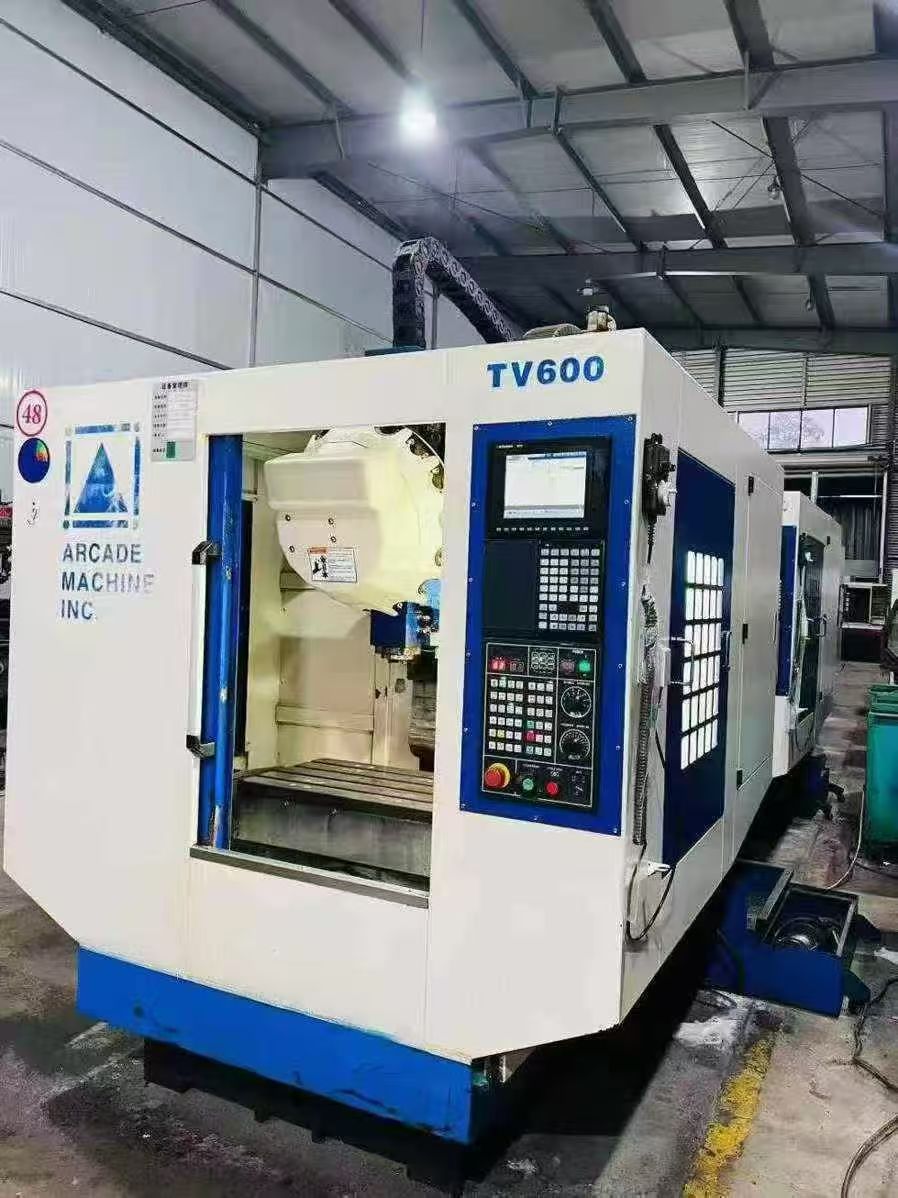
Choose by the shape of your parts, not by the machine. If most of your parts are round — shafts, bushes, flanges, threaded parts — a used CNC lathe, also called a turning center, will usually cut them faster, cheaper and more accurately. If most of your parts are prismatic — plates, brackets, mould components, housings with pockets, slots and holes on several faces — a used CNC machining center is the right platform. When your part mix is genuinely split, batch size decides: small batches and one-offs favour the machining center's flexibility, while repeat runs of round parts favour the lathe's cycle time. Before paying for either machine, check the wear points that differ between the two — and ask for a measured test cut, not just a video of the spindle turning.
Start from the part, not the machine
The most common mistake in this decision is to compare machines first. Two machines can both be in good condition and sensibly sized, and still be the wrong purchase — because the part was never described first. Before looking at any listing, answer four questions about the work the machine will actually do. The answers point at the machine category on their own, and they are also the information a sourcing partner needs to search for a suitable used machine on your behalf.
- Are the parts round or prismatic? Round parts rotate around one axis: shafts, pins, bushes, rings, flanges, threaded components. Prismatic parts are built from flat faces, pockets, slots and holes: plates, brackets, housings, mould plates, valve bodies.
- How many faces need machining? A part machined on one face is a different job from a part that needs five faces held to one datum. Each extra face is a setup, a fixture and a chance to lose accuracy.
- How big and how heavy is the largest part? Size sets the travel, the table or chuck capacity, and the weight the machine must carry without losing rigidity.
- How many pieces, and how often? One-offs, prototypes and small batches reward flexibility. Repeat runs reward cycle time and unattended running.
Count the parts you make or currently send out, and split them into round and prismatic. Most workshops find one shape dominates — that is your answer. If the split is genuinely even, batch size and the cost of a second setup decide.
| What you are machining | Machine to start with | Why |
|---|---|---|
| Shafts, pins, bushes, rings, flanges, threaded parts | CNC lathe (turning center) | Turning a round part is faster, cheaper and more concentric than milling it. One setup holds the diameter, the face and the thread. |
| Plates, brackets, mould components, fixtures | Vertical machining center (3-axis) | Best price-to-performance for prismatic work, simplest fixturing, easiest to load and operate. |
| Box-type parts: gearboxes, valve bodies, pump housings | Horizontal machining center | A rotary table indexes the part to each face, so four faces are machined in one setup instead of three or four. |
| Large, heavy or long plates and structural parts | Gantry machining center | The table carries the weight and the gantry spans it, so rigidity holds over a long travel. |
| Small-diameter parts under about 20 mm with tight concentricity | Swiss-type lathe | Bar stock is supported close to the cutting point, so deflection stays near zero on slender parts. |
| Round parts with some milling: keyways, flats, cross holes | Turning center with live tooling, or a turn-mill | The part is turned and milled without being released, so the milled features stay true to the turned diameters. |
What a used machining center does best
A machining center is a CNC milling machine with an automatic tool changer: the spindle turns the cutting tool while the table moves the workpiece through it. A three-axis center moves in X, Y and Z, so each new face needs the part to be refixtured. A four-axis center adds a rotary table; a five-axis center tilts the tool or the table on two extra rotary axes, keeping the cutter normal to curved surfaces — the right choice for impellers and mould cavities with undercuts.
For a first used purchase, the three-axis vertical machining center is the default choice for most workshops, and the used market reflects that: vertical centers are the most common, the easiest to inspect, and the simplest to fixture with a vice or a chuck. Choose a horizontal center when the part is box-shaped and needs four or five faces machined in one setup; choose a five-axis center only when the part geometry genuinely needs it, because five-axis programming takes longer and the machine must be verified on a test cut before you can trust it.
One cost buyers underestimate is tooling. On a machining center, the cutters, toolholders, vices and measuring instruments usually cost more than the equivalent equipment on a lathe, and they are rarely all included with a used machine. When comparing two used centers, ask what tooling, holders and workholding are included, and treat a machine sold bare as a machine with a further purchase attached. See our CNC machine tools category for the types covered and the specification points — travel, spindle, tool magazine and control system — that belong in a sourcing brief.
What a used CNC lathe does best
On a lathe the workpiece turns and a single-point tool feeds along X and Z. Anything with rotational symmetry belongs here. A CNC lathe holds concentricity between diameters, faces and threads in a way a milling machine cannot match without multiple setups, and it does so at a cycle time a machining center cannot match on round parts. For shafts and bushes in repeat batches, the lathe is not just the cheaper machine — it is the faster one, and the accuracy comes from the process rather than from careful refixturing.
Modern turning centers add capability without changing that core strength. Live tooling spins cutters in the turret, so a keyway, a flat or a cross hole can be milled without releasing the part. A Y axis moves the tool off centerline for more complex milled features, and a sub-spindle picks the part up and finishes the second end in the same cycle. A Swiss-type lathe feeds bar stock through a guide bushing, supporting small-diameter parts close to the cut — the right platform for connectors and other small precision parts.
None of this makes a lathe a substitute for a machining center. Live tooling mills slowly compared with a real spindle, the milling envelope is small, and a part that is mostly prismatic will always be produced more economically on a center. The question is proportion: if milling is an occasional feature on round parts, a turning center with live tooling is the efficient answer. If milling is the main operation, buy the machining center.
When one machine can do both — and when it cannot
Turn-mill machines and multitasking centers finish complex parts in a single setup, and for production work that is a real advantage: no second setup, no refixturing error, no work in progress waiting between machines. But a machine that does both is more complex to program, more expensive to maintain, and harder to verify when bought used — there are simply more systems that can be worn, and a fault in one of them can idle the whole machine.
For a workshop buying its first used CNC machine, two simpler machines often give more flexibility and cost less to maintain than one complex multitasking machine, and one machine can keep working while the other is being serviced. The exception is a part that cannot tolerate a second setup: if the tolerance between a turned diameter and a milled flat is tight enough that refixturing would break it, a single-setup machine is not a luxury, it is a requirement. That is a decision to make from the drawing, not from the catalogue.
Batch size, setup time and the cost of a second setup
When the part mix is split, batch size is the tie-breaker. A machining center earns its keep on variety: change the program, change the fixture, and the next part is a different shape. A lathe earns its keep on repetition: once a shaft program is proven, the machine repeats it with minimal attention, and a bar feeder can keep it running between operator visits.
Count setups, not machines. A prismatic part that needs three setups on a three-axis center, versus one setup on a horizontal center, is a different production cost even if the two centers look similar on paper. A round part with milled features that needs turning on the lathe and then a second setup on the mill carries a refixturing error, a queue between machines, and a second operator intervention. When the tolerance between the turned and milled features is loose, that is acceptable. When it is tight, it is not — and that is when a turning center with live tooling, or a turn-mill, pays for itself.
Buying used: the wear points are different
Year matters less than condition on both machine types, but condition shows up in different places. On a lathe, wear concentrates on the bed near the chuck, where most cutting happens. On a machining center, it concentrates in the middle of the table travel and in the spindle and tool changer. Knowing where to look keeps an inspection focused.
| What to check | Machining center | CNC lathe |
|---|---|---|
| Guideways and ballscrews | Wear in the middle of table travel; backlash on all three axes; listen for roughness on rapid moves. | Wear on the bed near the chuck; cross-slide and tailstock alignment; check for a worn section the carriage dwells on. |
| Spindle | Runout at the taper, noise and heat under load, drawbar force; ask for spindle hours and any rebuild record. | Runout at the chuck, bearing noise under load, and whether the spindle holds speed and torque at low revs. |
| Tool system | Automatic tool changer: full magazine change without alarms, tool change time, worn pockets, missing tools. | Turret indexing: every station, repeatability, live tooling stations if fitted, and clamping force. |
| Accuracy evidence | Measured test cut: pocket dimensions, hole positions across the table, surface finish on a finishing pass. | Measured test cut: diameters along the shaft, concentricity between diameters, thread fit, surface finish. |
| Control system | Controller model and age, parameter and program backup, availability of manuals and electrical drawings. | Same checks apply; also confirm the bar feeder or parts catcher, if fitted, is included and working. |
| Hours and history | Power-on hours, cutting hours and alarm history tell different stories; ask for all three, not just the year. | Same; also ask what the machine produced — continuous production wears differently from occasional prototype work. |
On either machine, the decisive evidence is a measured test cut: a part machined on the machine, measured with instruments, with the results recorded against the drawing. A short video of a spindle turning only proves the machine switches on. Agree the test and the acceptance limits in writing before the inspection, so the result is a decision rather than an argument. Our inspection service describes how condition and availability are checked before any specific offer is confirmed, and our guide to verifying a used machine seller in China covers the company, document and payment checks that sit alongside the technical ones.
What to ask before you commit
Whichever type you choose, the same short list protects the purchase. Ask for it before paying a deposit, not after.
- Identity: clear photographs of the nameplate and serial number, and confirmation that the model, year and capacity match the quotation.
- History: year of manufacture, power-on and cutting hours, alarm and repair history, and what the machine was producing.
- Condition evidence: a continuous test video under load and a measured test cut with results, not just a spindle-running clip.
- Control and documentation: controller model, parameter and program backup, operation manual and electrical drawings where available.
- Included equipment: chucks, vices, toolholders, live tooling, bar feeder, chip conveyor — listed in writing, with anything missing priced as a further purchase.
- Acceptance terms: inspection and acceptance criteria agreed in writing, with what requires repair, what justifies a price adjustment and what justifies rejection.
- Export readiness: dismantling, rust protection and packing, and the documents needed to ship — our guide to total import cost beyond the machine price explains the landed-cost items that sit around the machine itself.
Put the part first in your sourcing brief
If you ask a sourcing partner to find the machine, the brief should start with the part, not with a machine model. Send the drawing or a clear description of the part, the material, the tightest tolerance, the batch size and frequency, and the destination country. A brief written that way is answered with a machine that fits the work; a brief that only names a model is answered with that model, whether or not it fits.
State the machine type you have chosen and why — machining center or lathe, and which axis and tooling configuration the parts need — and name the acceptance test you will require. A seller who can meet a specific, written brief is a seller worth proceeding with. One who answers a detailed brief with a generic price and a stock photograph has not yet shown you a machine.
Frequently asked questions
Can a machining center replace a lathe?
For small numbers of round parts, yes. For repeat round work it is the wrong tool: slower, less concentric and more expensive per part than a lathe. Buy the machine that matches the dominant part shape.
Which type is cheaper to run?
Tooling and workholding usually cost more on a machining center than on a lathe, and a machining center typically needs more floor space and more setup time per part number. The lathe is usually cheaper per round part in repeat batches. Compare running cost per part, not the machine alone.
Should I buy one turn-mill instead of a lathe and a machining center?
When a part cannot tolerate a second setup, a turn-mill is the right answer. When the two operations can be split across two machines without breaking tolerance, two simpler machines are usually more flexible, easier to maintain, and keep working when one is serviced.
Does the year of manufacture decide which used machine is better?
No. Condition, measured accuracy and service history decide. A well-maintained older machine with a documented test cut beats a newer machine with worn guideways and no evidence.